
Hale County VINELink Is Now IVSS
Texas changed county custody notifications on September 1, 2025. The Texas Attorney General says the state moved from VINE to Texas IVSS-Counties, supplied by Sylogist. Existing VINE registrations transferred, and users were prompted to update passwords. Current instructions must therefore come from the IVSS portal, not an archived VINELink guide.
IVSS is built for a specific-person check and notifications. The portal says it covers people currently in custody or under supervision and warns that people no longer in custody may not appear. This makes a positive match or alert useful as a lead. It also makes an empty result weak evidence. The person could be released, transferred, outside a participating data source, entered under another identifier, or absent because of a data issue.
The official transition notice identifies phone, text, and email alerts. IVSS support is available at (866) 268-8959, 24 hours a day. Support can help with the portal, but the jail, TDCJ, or court remains the source for the underlying event.
Search One Hale County Inmate
Gather more than a name before searching. IVSS accepts several identifiers because names can repeat and spellings can vary. A DOC ID, SID, jail ID, or permanent booking number is stronger than a shared name. Compare the location and status with what is already known about the Hale County booking or TDCJ case.
- Open Texas IVSS-Counties and enter the person’s full or partial name, DOC ID, SID, jail ID, or permanent booking number.
- For a name search, use first and last together when possible. The portal permits partial-name searching.
- Complete the captcha. Review all returned matches rather than choosing the first similar name.
- Open the record only after comparing identifiers, location, and custody or supervision information.
- Read the status as of the displayed update. “Unknown/Undisclosed” can reflect a pending court matter.
- If there is no result, move to the sheriff, TDCJ, and court verification path. Do not record the absence as proof of release.
For Hale County Jail, ask the sheriff for the booking and release event when IVSS is empty or unclear. For Formby Unit or Wheeler Unit, use TDCJ’s statewide record because those are state prisons. A federal defendant or BOP prisoner belongs in the federal system, not IVSS. Identifying the custody system first prevents the most common false negative.
The broader Hale County released-inmate search covers the county record, state search, and court fallback. IVSS should remain one channel in that chain, not the final answer to every release question.
What Hale County IVSS Shows
The live result is oriented toward present custody or supervision. It can identify a person and the reporting setting, but it is not a complete booking packet, court disposition, or discharged-person archive. Exact fields can change with the portal and source feed.
| Field or input | How to use it |
|---|---|
| Full or partial name | Find possible matches, then compare stronger identifiers. |
| DOC ID or SID | Distinguish a state-system record from people with similar names. |
| Jail ID or permanent booking number | Tie the result to a particular county booking where supplied. |
| Custody or supervision status | Read the person’s reported present relationship to the system. |
| Location | Identify the reporting facility or supervision setting where disclosed. |
| Unknown/Undisclosed | May reflect a pending court case; it is not a release finding. |
| Notification methods | Select available phone, text, or email notice for the matched record. |
A release date displayed in an alert or status change should be verified against the originating agency. Hale County Jail can record a local release or transfer. TDCJ records the state-prison event. A court order explains legal authority but may not show the time the person physically left.
Note: IVSS identifies itself as non-official information, so preserve an alert as a lead and obtain the agency record for proof.
Hale County IVSS Search Screen
The official Texas IVSS portal shows the current search and notification entry point used for a specific Hale County person.
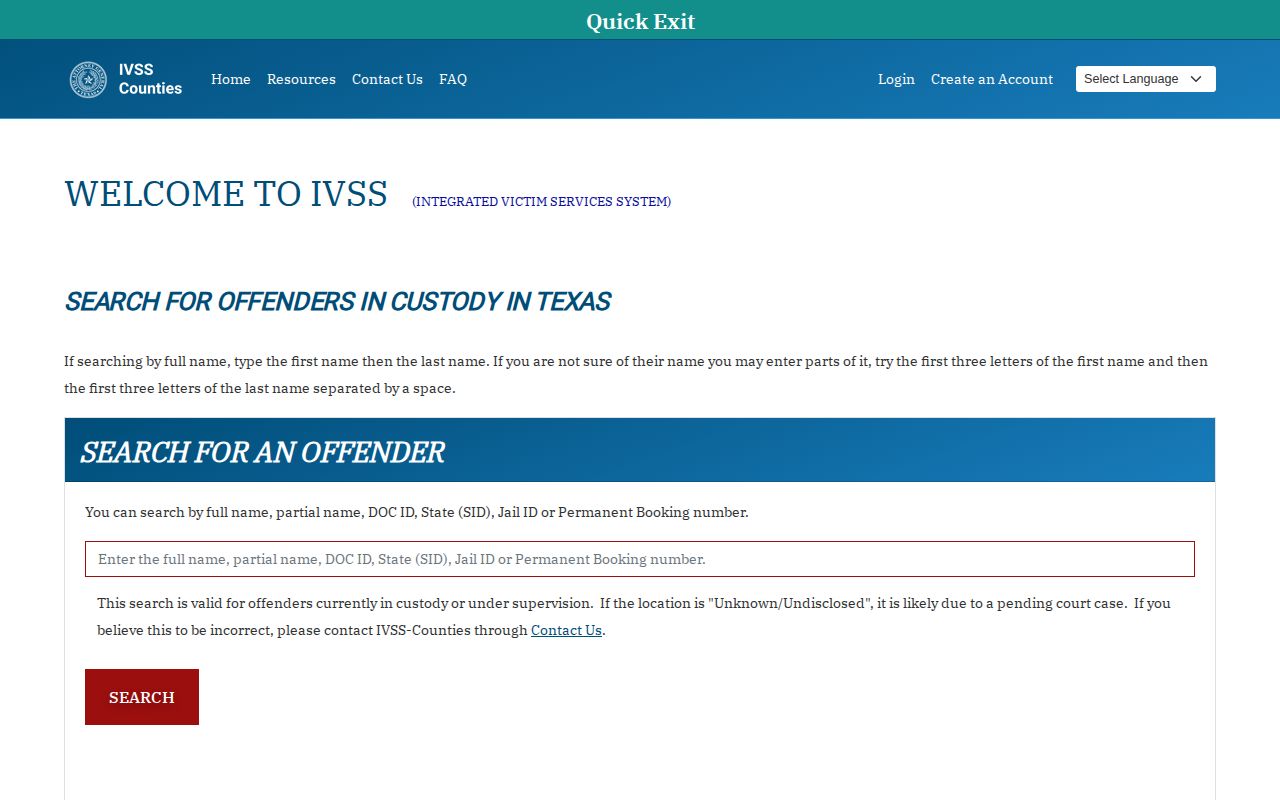
The interface should be read at the time of use because fields, confirmation steps, and available methods can change after the 2025 migration.
Register a Hale County Release Alert
Registration begins from the correct person’s live record. The IVSS landing page says notifications can be requested with or without an account. An account can help manage preferences and history, but the live options control what is available for the chosen record.
- Select the correctly matched in-custody or supervised record.
- Choose the request-notifications action shown on that record.
- Select the available phone, text, and email methods that fit the need.
- Enter the requested contact and verification information. Follow the current on-screen confirmation step.
- Save the registration details. Review preferences, contact data, blackout times, and notification history when those controls are available.
- When an alert arrives, contact the reporting jail or TDCJ to verify whether the event was release, transfer, supervision change, or another update.
Do not publish personal notification data or use another person’s private account. A lawful public screenshot should show only the landing page, search form, or a result that does not expose private victim information. The alert exists to give prompt notice, not to replace an official record.
Phone, text, and email delivery can fail because contact data changed, service was interrupted, or the source feed lagged. Keep more than one method when the portal permits it. Update preferences after changing a number or email address.
Legacy Texas VINE PIN Instructions
Older Texas VINE material used a different phone process. A registrant created a four-digit PIN, and an automated call asked for the PIN followed by the pound key to acknowledge notice. Calls could repeat when they were not acknowledged. Multiple phone or email contacts could be registered.
That description is historical. No current official source establishes that IVSS uses the same four-digit PIN flow. Follow the live IVSS verification step instead. The old toll-free number and VINELink URL should not displace the current portal and IVSS support line.
This distinction matters after the statewide migration. A transferred legacy registration may remain active, yet the user may need a password update or current contact confirmation. Verify the saved record and preferences in the present system.
Hale County Notification Limits
The 2025 migration is Hale County’s key local notification issue. The Attorney General warns that not every Texas county is set up. Coverage should be checked in the live portal. Even when a Hale record appears, IVSS is geared to current custody, supervision, and notification. It does not become a 24-hour or 72-hour released-person archive.
A person who has fully left custody can vanish from the active search. That design makes IVSS useful before and during a custody change, but less useful for proving an old event. Existing VINE registrations transferred, yet that does not expand the archive. For retrospective proof, request the Hale County booking and release record or the TDCJ prior-incarceration and release history.
Hale County also has distinct local and state facilities. A jail ID may point to Hale County Jail. A DOC ID or SID can lead to TDCJ information for Formby, Wheeler, or another prison. Compare the facility and agency before treating an alert as the expected release.
Confirm a Hale County IVSS Alert
IVSS does not cover every custody system. It is not the Federal Bureau of Prisons locator, a complete US Marshals history, or an ICE release certificate. For a sentenced federal prisoner, use the BOP Inmate Locator. A federal court docket may explain an order. Immigration custody uses the ICE locator and agency channels.
Data also can lag. TDCJ’s public search says its own information is at least 24 hours old and updated on working days. County feeds have their own update paths. A just-completed transfer can therefore appear differently across two systems for a time.
Ask the source agency for the release date and time, release type or authority, and destination or receiving agency. These fields distinguish freedom from a custodial transfer. Then pair the physical event with the court or supervision record when legal context matters.
Separate Release and Registry Records
The Texas DPS Sex Offender Registry is a different post-release channel. It covers only people with a statutory registration duty. Registry presence does not show that a person just left Hale County custody, and absence does not answer the general release question. Parole, registry, jail custody, and release are separate facts.
Use each system for its defined purpose. IVSS sends custody or supervision notice. The jail or TDCJ documents release. The court supplies the order and case outcome. Keeping those roles separate produces a more accurate result than relying on one name search.
Note: A current notification, a supervision record, and a completed release record may describe the same person but prove different facts.